Paula J Blum, World Language Department Chair Shining Mountain Waldorf School and Association of American Teachers of German (AATG)  Professional Consultant

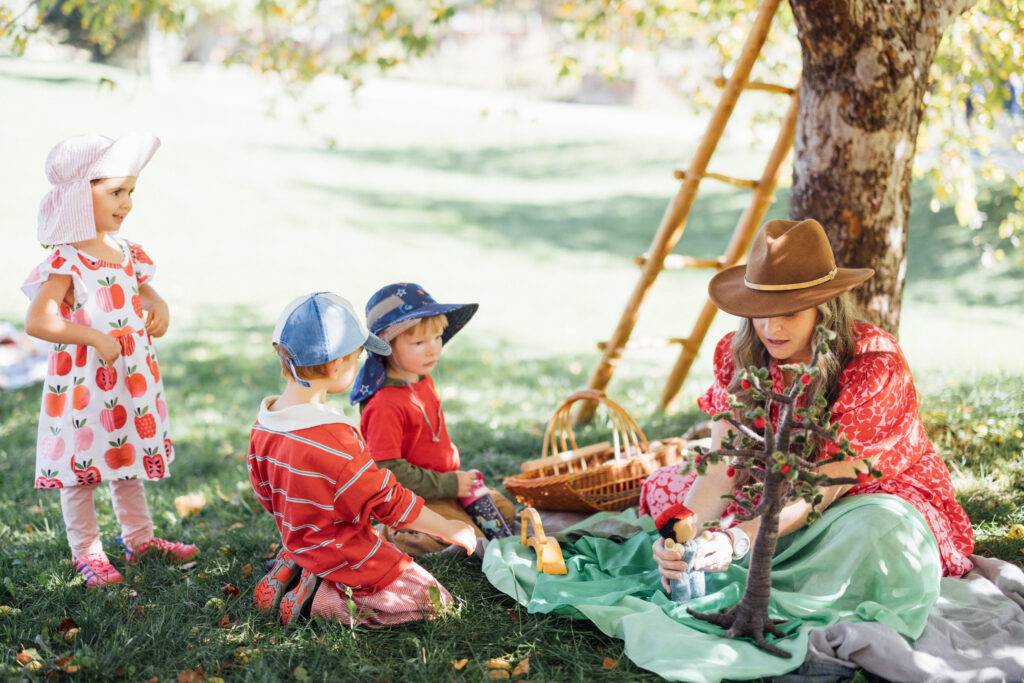
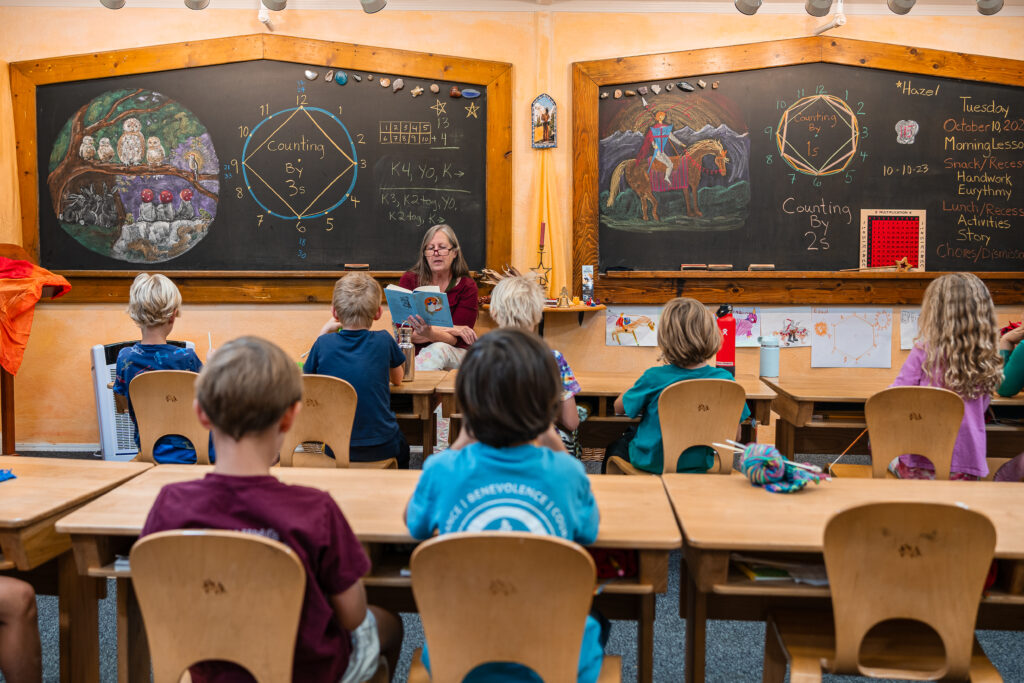
“Kopf, Schulter, Knie und Zehe” sings the first grade German class as they touch their heads, shoulders, knees and toes. Frau Geck, Lower School German teacher at Shining Mountain Waldorf School in Boulder, Colorado, then launches into a game of “Frau Geck sagt” (Simon says). The children balance on one leg, jump up in the air, stand on their chairs and touch their nose, laughing if they do it at the wrong time. Later in the day, third graders join in the retelling of  “Die Drei Kleinen Schweinchen” (The Three Little Pigs), giggling when Frau Geck sucks in her cheeks and makes herself look as thin as possible to emphasize how small the wolf has to make himself to fit down the chimney. In these lower school language classes, the students are completely engaged not really noticing that Frau Geck is speaking only German. Across the road in a classroom at the high school, seniors discuss in German the effects of Alzheimer’s on family members and relate stories about people they know with dementia. How did these seniors get from being participatory imitators in the first few grades to being able to converse about a wide range of topics with fluency in the 12th grade. Why do we consider languages so important in a Waldorf school and what kind of fluency can parents expect for their child while in the lower school/middle school language program and at the end of their twelfth grade year?
At Shining Mountain Waldorf School, we teach two languages (German and Spanish) from first grade through eighth and then students choose one of those two languages to continue with through 12th grade. When Rudolf Steiner advised on the curriculum for the first Waldorf school in Stuttgart nearly 100 years ago, he recommended teaching the children two foreign languages in addition to their mother tongue. Stockmeyer1 quotes a passage from a magazine article written by Steiner in 1898 where Steiner stated what the task of a teacher is:

“Primary schools have the enviable task of making the young people into real
people in the truest sense of the word. There the teachers must ask themselves
what natural talents are hidden in every person and what they must bring out in
each child so that the pupil may finally realize his own humanity in balanced
integration.”2

Teaching students is not just about teaching them content, or in our case, a new language. It is “to make the child into a full human being.”3 In a lecture in 1923, Steiner said,

“In Waldorf schools, we follow our feeling that we can indeed help our students develop fully as human beings and find their place in the ranks of humankind. This must be our primary consideration when teaching languages… An outstanding feature of language instruction, however, is that at a Waldorf school we begin teaching two foreign languages… as soon as children begin school at six or seven. Thus we try to give them something that will become increasingly necessary in the future.”4

Steiner went on to explain that a language is deeply rooted in a person’s being. Each language expresses the human element in a different way. Steiner advocated for the teaching of more than one language so that the languages could balance each other in the way they affect human nature. For instance, one language might work on the will whereas another might work on the imagination.5 Learning another language also helps with the schooling of empathy because the students learn to relate to how others feel and think.6 During lectures given in Dornach, Switzerland in 1923, Steiner talked about the goals of language teaching:

“To briefly summarize the aims of language teaching, children should first develop, step by step, a feeling for the correct use of language, then a sense of the beauty of language, and finally the power inherent in linguistic command.”7

How do these goals relate to how much fluency a parent can expect when their children are in the World Language program at a Waldorf school? First of all, we need to discuss what actually is fluency. The American Council on the Teaching of Foreign Languages (ACTFL) defines fluency as “the flow in spoken or written language as perceived by the listener or reader. Flow is made possible by clarity of expression, the acceptable ordering of ideas, use of vocabulary and syntax appropriate to the context.”8 Therefore, the fluency is dependent on who is listening to you talk or reading what you have written. Kerstin Hammes, editor of the Fluency Blog, argues that it is difficult to define what fluency is and “as a goal it is so much bigger than it deserves to be. Language learning never stops because it’s culture learning, personal growth and endless improvement.”9 According to the ACTFL Oral Proficiency Interview (OPI) Ratings, the number of contact hours necessary for a student to become an “intermediate” language learner (ability to ask and answer simple questions) is: 480 hours for German and 240 hours for Spanish.10 Please note: These rating are for adult language learners who complete full-time intensive and/or immersion, proficiency-based language training under the supervision of an instructor and with 1-4 students per class. To put our 1-5 lower school World Language program at SMWS in perspective, our students receive 42 hours of instruction per year in German, and 42 hours in Spanish. For students who have been here since 1st grade, that’s a total of 210 hours, for each language. Of course, these are mostly non-consecutive, spread-out hours of elementary school children, as opposed to adults trying to learn a language for their career. As you can see, our numbers fall far short of the intermediate levels. This is one of the reasons why fluency is not a primary goal of our World Language program in the lower school. Rather, we are building a foundation for students to continue to deepen their studies as they progress into middle and high school. Johannes Kiersch points out that “the first stage of learning and speaking a language is bound up with quite specific situations. It is therefore advisable to enlighten parents on this matter, just in case they wonder why Waldorf pupils almost invariably behave outside the classroom as if they had never had any access to the school’s progressive language teaching. It can take years before children are able to free what they have learned from the classroom situation and use it outside school.”11 For example, in order for Frau Geck’s third graders to join in the retelling of “Die Drei Kleinen Schweinchen”, they needed to look at the felt board figures and have Frau Geck there saying it with them. Indeed, they needed to imitate Frau Geck. Steiner talked about this developmental stage of imitation:

“… until nine or ten, children bring with them enough imaginative imitation to enable us to teach a language so that it will be absorbed by their whole being, not just by their forces of soul and spirit.”12

It is during this imitation phase that the children get a feeling for the correct use of language.
By the start of the middle school years, the students will have developed a feeling for the beauty of the language through the learning of poetry, hearing stories and singing songs. Again, we are not aiming for fluency, but instead we are enlivening the students via their feelings. From middle school on, the emphasis is on individualized language as the language teacher creates situations where the students can use their critical judgment and their own imagination. In high school when the students focus on the one language, they can start to build their fluency. At first, this is centered around familiar topics, but by junior year, the students are making jokes in the target language and are already able to discuss a wide variety of topics. When our SMWS seniors graduate in world languages, they can do the following:

  • Engage in conversations, provide and obtain information, express feelings and emotions, and exchange opinions.
  • Understand and interpret written and spoken language on a variety of topics.
  • Present information, concepts, and ideas to an audience of listeners or readers on a variety of topics.
  • Reinforce and further their knowledge of other disciplines through the world language.
  • Acquire information and recognize the distinctive viewpoints that are only available through the world language and its cultures.
  • Demonstrate understanding of the nature of language through comparisons of the language studied and their own.
  • Demonstrate understanding of the concept of culture through comparisons of the cultures studied and their own.

It is no wonder that our world language graduates skip levels when they go into language classes in college.
Parents should therefore not be concerned when their lower school child cannot tell them what they learned in the world language class. They can be assured that our 12th graders leave our school as global citizens, ready to communicate in the target language and interact with the world.
 

Endnotes

  1. E.A. Karl Stockmeyer, Rudolf Steiner’s Curriculum for Waldorf Schools, trans. Roland Everett-Zade. (East Sussex: Steiner Waldorf Schools Fellowship, 2001), 4.
  2. Rudolf Steiner, Essay “Secondary Education and Public Life” in “Magazine for Literature”, 1898 referenced in E.A. Karl Stockmeyer, Rudolf Steiner’s Curriculum for Waldorf Schools, trans. Roland Everett-Zade. (East Sussex: Steiner Waldorf Schools Fellowship, 2001), 4.
  3. Ibid.
  4. Rudolf Steiner,  A Modern Art of Education, (Great Barrington, MA: Anthroposophic Press, 2004), 151.
  5. Ibid, 152.
  6. Johannes Kiersch, Language Teaching in Steiner Waldorf Schools, (Sussex: Steiner Schools Fellowship Publications, 1997), 22.
  7. Rudolf Steiner, Soul Economy. Body, Soul and Spirit in Waldorf Education, (Great Barrington, MA: Anthroposophic Press, 2003), 222.
  8. American Council on the Teaching of Foreign Languages (ACTFL). “The ACTFL proficiency guidelines 2012 – Glossary.” 2013. Accessed June 18 2018. https://www.actfl.org/publications/guidelines-and-manuals/actfl-proficiency-guidelines-2012/glossary
  9. The Guardian, “Learning a Language. 10 things you need to know.” The Guardian. Accessed May 8 2018. https://www.theguardian.com/education/2014/oct/30/learning-another-language-ten-tips/
  10. Language Testing International, “How long does it take to become proficient?” Language Testing International. Accessed June 19 2018. https://www.languagetesting.com/how-long-does-it-take
  11. Johannes Kiersch, Language Teaching in Steiner Waldorf Schools, (Sussex: Steiner Schools Fellowship Publications, 1997), 64.
  12. Rudolf Steiner,  A Modern Art of Education, (Great Barrington, MA: Anthroposophic Press, 2004), 153.

SHARE THIS
Donna El-Hehiawy

HR Director

Donna resides in Boulder, Colorado, where she shares her home with her dog and cat and her visiting daughters, who are currently attending college. Originally from Encino, California, Donna moved to Colorado to pursue her education and graduated from the University of Colorado at Boulder with a Bachelor of Science in Human Resources. What began as a college journey quickly became a lifelong connection to the community she now calls home.

After graduation, Donna built a successful career in Human Resources, gaining more than 15 years of professional experience while also dedicating many years to active involvement in her daughters’ schools. Throughout her career, she has been known for her collaborative spirit,
strong organizational skills, and genuine commitment to supporting people and communities.

Donna brings enthusiasm, warmth, and a deep sense of purpose to her role at the Shining Mountain Waldorf School, where she is excited to support the school community.

Outside of work, she is an avid bicyclist and enjoys kayaking, exploring the outdoors, and capturing meaningful moments through photography.

Job Details

  • Job Title: Facilities & Grounds Assistant

  • Program: Administration

  • Reports to: Facilities & Grounds Director

  • FLSA Status: Non-Exempt

  • Date: January 2026

Position Summary

Shining Mountain Waldorf School (“SMWS”) is a PreK-12th grade campus consisting of 8 acres and 15 buildings located at the foothills of North Boulder, Colorado. In conjunction with the Facilities Director, the Facilities and Grounds Assistant provides year-round maintenance, seasonal upkeep, and improvement of school buildings and grounds to support our nature and outdoor school curriculum. Maintenance, safety, and improvement projects are essential to welcome visitors and the SMWS community to the natural beauty of the SMWS campus.

Essential Duties and Responsibilities

  • Required skills to address issues relating to campus maintenance: plumbing, electrical, carpentry, painting, HVAC, care of the grounds, etc.

  • Daily tour of campus and playground for hazards, trash, safety, and wildlife concerns

  • Daily response to requests for repairs and campus assistance

  • Daily late afternoon safety checks for campus and building safety

  • Weekly service and safety inspection of school buses (fuel, oil, tires, etc.)

  • Weekly cleaning and organizing of facilities and grounds workshop

  • Weekly safety inspections of playground equipment

  • Preparation for school events and meetings, including setup and breakdown of tables and chairs

  • Seasonal work, inspecting and maintaining classrooms, air conditioners, swamp coolers, furnaces, water heaters, thermostats, etc.

  • Supplement early morning seasonal and evening snow removal and ice management throughout campus in preparation for the student and parent arrival and departure of the school day

  • Delivery and moving of items throughout campus classrooms and buildings

Additional Responsibilities

  • Outdoor work, walking, repairing, and attention to our 8-acre campus

  • School events set up and break down – festivals, concerts, and plays   

  • Driving ability to include driving school truck with trailer   

  • Working knowledge of automotive care and maintenance   

  • Working with faculty and assisting in moving and preparing classrooms   

Education and Qualifications

  • Familiarity with landscaping and irrigation, plumbing, electrical, carpentry, painting, HVAC, and general maintenance items

  • Friendly and approachable temperament working with faculty, staff, students, and community

  • Previous construction, trade, and technical skills

  • Self-starter in recognizing and completing necessary campus needs and maintenance

  • Skill and ability to operate power tools in accordance with proper safety guidelines

  • Basic computer skills

  • Driver’s license required with excellent driving record

  • Available to work a flexible schedule at times when work is needed outside of normal working hours – early mornings and weekends (early/late snow removal, event set up and break down, facilities emergencies, etc.)

Work Setting

  • Status: Full time – 40 hour a week non-exempt position

  • Type: This is an hourly, year-round position

  • Hours: 8:30 am to 4:30 pm (may require some early morning and evening hours)

  • Environment: Work setting varies based on assignment – indoor and outdoor work on campus and buildings

Salary and Benefits

  • Pay: Hourly wage of $25.00 per hour – overtime paid (time and ½) when over 40 hours are worked per week

  • Time Off: Personal Time Off (monthly accruals of 2 weeks and 3 weeks after 1+ years)

  • Sick Leave: Colorado Paid Sick Leave (1 hour earned each 30 hours worked up to 48 hours each calendar year)

  • Holidays: Up to 15 Paid National Holidays per calendar year, including a paid week during the December holidays

  • Benefits: Medical, dental, vision, life insurance, long-term disability, 401(k) with match (determined annually), flexible spending account, and other ancillary benefits

Physical Requirements

The physical demands described here are representative of those that must be met by an employee to successfully perform the Essential Duties and Responsibilities of this job. While performing the duties of this job, the employee must be able to perform:

  • General construction work-related requirements, including but not limited to: lifting, bending, standing, kneeling, carrying items, working on a ladder, etc.

  • Ability to lift at least 60 pounds

  • Work in tight spaces – work may be in small spaces within buildings, crawl spaces, and frame restrictions

  • Reasonable accommodations may be made to enable qualified individuals with disabilities to perform essential functions. 


Interested candidates should send a cover letter, resume, and three references to hrmgr@smwaldorf.org


Shining Mountain Waldorf School is fully committed to Equal Employment Opportunity and to attracting, retaining, developing, and promoting the most qualified employees without regard to their race, religion, gender, gender identity, disability, familial status, sexual orientation, or national or ethnic origin, citizenship status, veteran status, or any other characteristic prohibited by state or local law. We are dedicated to providing a work environment free from discrimination and harassment, where employees are treated with respect and dignity. 


Job Details

  • Job Title: Substitute Teacher

  • Program: Grades 1 through Grade 12

  • Reports to: Campus Operations Director

  • FLSA Status: Non-Exempt

  • Date: October 2024

Position Summary

Shining Mountain Waldorf School, a PreK to High School, is seeking Substitute Teachers. In order to create an encouraging learning environment for students while their regular Teacher is absent, our Substitute Teachers will need to effectively manage and instruct the class. We are looking for individuals who have teaching experience, love the classroom environment, and are available (sometimes on very short notice) to work during the week. Knowledge of Waldorf education is a plus.

Essential Responsibilities

  • Teaching and supervision of students in the event that their regular teacher is unable to lead class.

  • Manage classroom behavior and follow lesson plans provided by the regular Teacher to create a cohesive and consistent learning experience for students.

  • Manage the classroom effectively to encourage student participation, minimize distractions and maintain a positive learning environment.

  • Adapt teaching methods to fit the needs of each individual student.

  • Supervise students in and out of the classroom, including in class transitions, and on the playground.

Work Setting

  • Classroom and playground environment

Salary and Hours

  • Pay: $25 per hour with a 2-hour daily minimum

  • Timesheets are required to be completed

  • Substitute Teaching hours vary and are contingent on SMWS Faculty absences from the classroom and class needs

  • Calls to Substitute Teach may be made on very short notice – evening and morning hours

  • Substitute hours are based on SMWS need for classroom coverage

Education and Qualifications

  • Bachelor’s Degree

  • Teaching experience and classroom experience required

  • Comfortable with students and academic focus

Physical Requirements

The physical demands described here are representative of those that must be met by an employee to successfully perform the Essential Duties and Responsibilities of this job. While performing the duties of this job, the employee must be able to perform:   

  • Sitting and standing for class presentations   

     
  • Lift 25 pounds, bending, stretching   

     
  • Mobility to move about the classroom, walking around our 12 -acre campus, and playground   

     
  • Reasonable accommodations may be made to enable qualified individuals with disabilities to perform essential functions.  

 
Interested candidates should submit a letter of interest and resume to hrmgr@smwaldorf.org.


Shining Mountain Waldorf School is fully committed to Equal Employment Opportunity and to attracting, retaining, developing and promoting the most qualified employees without regard to their race, religion, gender, gender identity, disability, familial status, sexual orientation or national or ethnic origin, citizenship status, veteran status, or any other characteristic prohibited by state or local law. We are dedicated to providing a work environment free from discrimination and harassment, where employees are treated with respect and dignity.


Kim Rector
Kim Rector

Admissions Director

Kim brings more than 12 years of dedicated experience in Advancement and Admissions within Waldorf Education. Kim’s journey with Waldorf Education began in 2013 at the Austin Waldorf School, where she discovered a deep passion for Waldorf pedagogy and Anthroposophy. After relocating to Colorado in 2014, Shining Mountain Waldorf School quickly became a second home for her family. That same year, Kim stepped into the role of Lower School Receptionist, marking the start of nearly a decade of service and leadership at SMWS.

With over 15 years of experience in non-profit fundraising and event management, Kim was a natural fit for the position of Development Director at Shining Mountain, a role she held from 2017 to 2020. She then transitioned into Admissions, serving as Admission Director from 2020 until her family’s return to Austin in 2023. Kim continued work in Waldorf Education by serving as Admission Director at the Austin Waldorf School for the following three years.

Kim studied Biochemistry at Texas State University and has completed her Foundation Studies in Anthroposophy.

Outside of her professional life, Kim and her husband, Julian, are parents to their three children, Sydney, Suri, and Julian. Together, they enjoy hiking, fishing, camping, skiing, and cooking as a family.