
By Joshua Berman

This article was originally published in The Boulder Daily Camera’s “Raised in the Rockies” Family and Parenting Guide on August 1, 2022


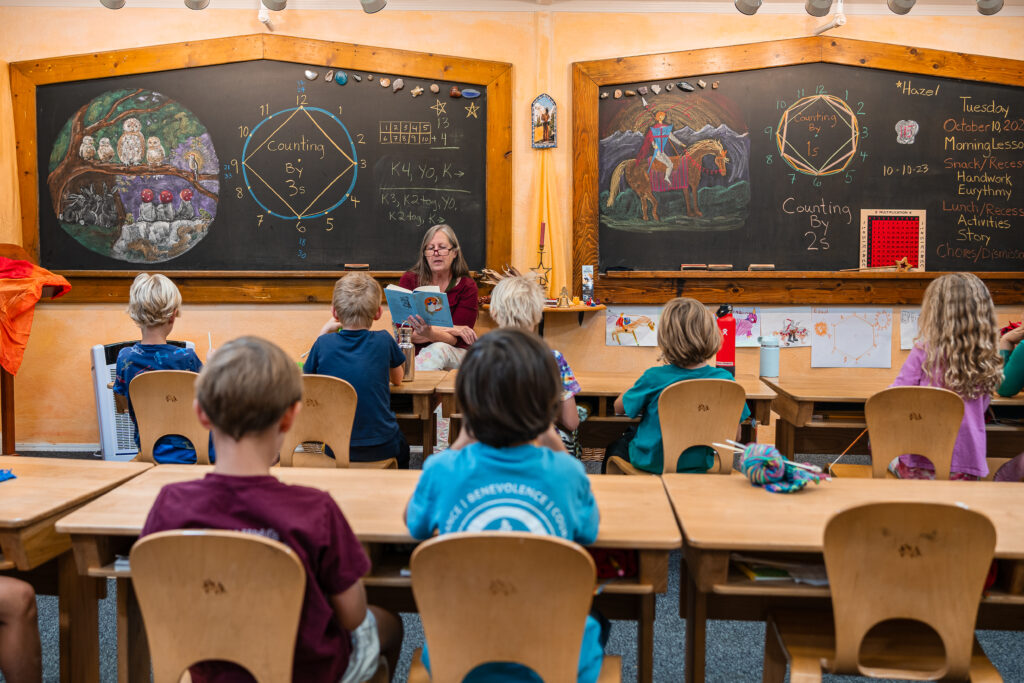
An excited cluster of sixth graders surrounded the table where I’d placed an assortment of devices — an old iPhone, PC and laptop. I was about to remove the side panel from an old hard drive and the suspense was thick in the air. We’d just learned the names of the main components and, as I revealed the colored wires and electronic innards, I instructed the students to remove any parts they could. They eagerly complied.

Today’s Tools
I was teaching a lesson called “Investigating Today’s Tools,” a part of the sixth grade Cyber Civics curriculum. The students’ eagerness to place the sharp-edged computer parts in their hands was fun to watch. These were not the fuzzy, felted wool toys and soft beeswax sculptures that had occupied many of these hands only a couple of years ago. These were hard, modern objects and the students were fully involved in trying to identify them — was this the motherboard, the central processing unit, or the video card? They buzzed and discussed and discovered.

Part of their mood was natural middle schooler curiosity, but with this class, there was something else at play. There was this slightly forbidden feeling of seeing a pile of tech in a Waldorf classroom. After all, Waldorf schools are famously low/no tech, at least in the pre-K through fifth grade classrooms, and this is still generally true. But even those spaces had screens in them during parts of the pandemic, when tech pushed further into our lives as we sought to stay connected.

Middle school is often where it starts, exposure to — participation in and consumption of media and social media. It is common for students to come home declaring, “I’m the only one in the class who doesn’t have [insert the latest device]!”

So the timing of this lesson was perfect. After pulling apart the various devices, each student chose a component to bring back to their desk to draw and then illustrate how they think it works. The objective of the lesson is to demonstrate to students that these devices are merely tools; that it’s how we use them that determines what kind of experience we’ll have, and what kind of people we can
be, online.

Cyber Civics
The Cyber Civics curriculum was developed by Diana Graber, a teacher at the Journey School in California who has an MA in media psychology and social change. She is also the author of Raising Humans in a Digital World, a must-read for any modern parent.

“We want to teach students that they’re the master of the tool,” said Graber in a telephone interview, “and that the tool is not the master of them.”

Cyber Civics is taught in 90 percent of North American Waldorf schools and a rapidly growing number of public schools as well, in 48 states. The lessons are grouped into three levels: digital citizenship, information literacy and media literacy, each of these taking a full year, taught in grades 6, 7 and 8, respectively. The course can be taught entirely offline, since it focuses on interpersonal skills before actual tech skills.

I’ve been teaching Cyber Civics at Shining Mountain Waldorf School for two years and the response from students and parents is thick with appreciation that we are helping students learn these skills. In the sixth grade, we also talk about digital reputation, hiding behind a screen, identity, avatars, digital drama, being an upstander, and what to do if you encounter cyberbullying or hate speech.

What Students Need
As screens and media work their way further into our lives, both at home and at school, the need to prepare our children to be safe and responsible members of the online world is as urgent as ever. Waldorf Education has always been about introducing the right topics and skills at the appropriate time in a child’s development, and so it goes with technology. This begins with addressing human capacities like the Golden Rule in earlier years, and then needs to get more explicit in middle school.

“Waldorf pedagogy was ready for this moment,” said Graber. “[It] is so well positioned to put children into the world who are critical thinkers, and then, when you layer on top of that teaching them how to use technology and teaching them about empathy — they are so far ahead of everyone else.”

“What students need is what the world needs,” declares the Cyber Civics website, which then quotes Rudolf Steiner in naming these needs: “imagination, a sense of truth, and a feeling of responsibility.” These critical human capacities also happen to be exactly what students need to become safe, ethical citizens, both in real life and in the digital world.

The questions for schools and parents then are: (1) How do we teach these topics before children enter the online world, or as Graber put it, how do we plant seeds of digital literacy while laying a “strong ethical thinking foundation”? (2) In middle school, how do we teach these capacities in relation to the internet? And (3) How does this education, especially media literacy, continue into the high school years?

Future Business Leaders
“It’s that human element,” said Graber. “When you talk to business owners around the world, they say that’s largely what young people are missing; they’re missing that empathy gene, that ability to look someone in the eye, to communicate face to face —that’s gold today.”

This reminded me of one of my first impressions of Waldorf education, before I started teaching. I was chatting with the owner of a neighborhood pizza shop called O’s, which used to be a couple of blocks from the Shining Mountain Waldorf School campus. “Oh, I can tell the Waldorf kids from the rest from the moment they walk in,” he said one day. “They look you in the eye and they are present.”

This was about 2006 or so, before the Internet took over the world, and now, years later, I realize how that simple mindful presence is still such a large part of the equation; and how finding evolving ways to teach it to students is key as they move between offline and online spaces.

Discovery
Back in the classroom, I sat back and watched the sixth graders settle into their drawing projects. Pencils and pens sketched away; hard drives and wires lay in disarray. I allowed this rare moment of quiet and concentration to linger in the classroom.

“We’re not really teaching it,” Graber said to me regarding the overarching objectives of the Cyber Civics curriculum. “We’re presenting activities where [students] discover this stuff on their own.”

By Joshua Berman, Shining Mountain Waldorf School. Joshua teaches Spanish and Cyber Civics at Shining Mountain Waldorf School in Boulder.


SHARE THIS

Stay Connected with Shining Mountain Waldorf School

Join our community and be the first to know about upcoming student events, adult education workshops, and open houses.

 
Preparing Our Kids for a Tech-Driven Future: Join Us at the Human Advantage Summit in Boulder

Job Details

  • Job Title: Facilities & Grounds Assistant

  • Program: Administration

  • Reports to: Facilities & Grounds Director

  • FLSA Status: Non-Exempt

  • Date: January 2026

Position Summary

Shining Mountain Waldorf School (“SMWS”) is a PreK-12th grade campus consisting of 8 acres and 15 buildings located at the foothills of North Boulder, Colorado. In conjunction with the Facilities Director, the Facilities and Grounds Assistant provides year-round maintenance, seasonal upkeep, and improvement of school buildings and grounds to support our nature and outdoor school curriculum. Maintenance, safety, and improvement projects are essential to welcome visitors and the SMWS community to the natural beauty of the SMWS campus.

Essential Duties and Responsibilities

  • Required skills to address issues relating to campus maintenance: plumbing, electrical, carpentry, painting, HVAC, care of the grounds, etc.

  • Daily tour of campus and playground for hazards, trash, safety, and wildlife concerns

  • Daily response to requests for repairs and campus assistance

  • Daily late afternoon safety checks for campus and building safety

  • Weekly service and safety inspection of school buses (fuel, oil, tires, etc.)

  • Weekly cleaning and organizing of facilities and grounds workshop

  • Weekly safety inspections of playground equipment

  • Preparation for school events and meetings, including setup and breakdown of tables and chairs

  • Seasonal work, inspecting and maintaining classrooms, air conditioners, swamp coolers, furnaces, water heaters, thermostats, etc.

  • Supplement early morning seasonal and evening snow removal and ice management throughout campus in preparation for the student and parent arrival and departure of the school day

  • Delivery and moving of items throughout campus classrooms and buildings

Additional Responsibilities

  • Outdoor work, walking, repairing, and attention to our 8-acre campus

  • School events set up and break down – festivals, concerts, and plays   

  • Driving ability to include driving school truck with trailer   

  • Working knowledge of automotive care and maintenance   

  • Working with faculty and assisting in moving and preparing classrooms   

Education and Qualifications

  • Familiarity with landscaping and irrigation, plumbing, electrical, carpentry, painting, HVAC, and general maintenance items

  • Friendly and approachable temperament working with faculty, staff, students, and community

  • Previous construction, trade, and technical skills

  • Self-starter in recognizing and completing necessary campus needs and maintenance

  • Skill and ability to operate power tools in accordance with proper safety guidelines

  • Basic computer skills

  • Driver’s license required with excellent driving record

  • Available to work a flexible schedule at times when work is needed outside of normal working hours – early mornings and weekends (early/late snow removal, event set up and break down, facilities emergencies, etc.)

Work Setting

  • Status: Full time – 40 hour a week non-exempt position

  • Type: This is an hourly, year-round position

  • Hours: 8:30 am to 4:30 pm (may require some early morning and evening hours)

  • Environment: Work setting varies based on assignment – indoor and outdoor work on campus and buildings

Salary and Benefits

  • Pay: Hourly wage of $25.00 per hour – overtime paid (time and ½) when over 40 hours are worked per week

  • Time Off: Personal Time Off (monthly accruals of 2 weeks and 3 weeks after 1+ years)

  • Sick Leave: Colorado Paid Sick Leave (1 hour earned each 30 hours worked up to 48 hours each calendar year)

  • Holidays: Up to 15 Paid National Holidays per calendar year, including a paid week during the December holidays

  • Benefits: Medical, dental, vision, life insurance, long-term disability, 401(k) with match (determined annually), flexible spending account, and other ancillary benefits

Physical Requirements

The physical demands described here are representative of those that must be met by an employee to successfully perform the Essential Duties and Responsibilities of this job. While performing the duties of this job, the employee must be able to perform:

  • General construction work-related requirements, including but not limited to: lifting, bending, standing, kneeling, carrying items, working on a ladder, etc.

  • Ability to lift at least 60 pounds

  • Work in tight spaces – work may be in small spaces within buildings, crawl spaces, and frame restrictions

  • Reasonable accommodations may be made to enable qualified individuals with disabilities to perform essential functions. 


Interested candidates should send a cover letter, resume, and three references to hrmgr@smwaldorf.org


Shining Mountain Waldorf School is fully committed to Equal Employment Opportunity and to attracting, retaining, developing, and promoting the most qualified employees without regard to their race, religion, gender, gender identity, disability, familial status, sexual orientation, or national or ethnic origin, citizenship status, veteran status, or any other characteristic prohibited by state or local law. We are dedicated to providing a work environment free from discrimination and harassment, where employees are treated with respect and dignity. 


Job Details

  • Job Title: Substitute Teacher

  • Program: Grades 1 through Grade 12

  • Reports to: Campus Operations Director

  • FLSA Status: Non-Exempt

  • Date: October 2024

Position Summary

Shining Mountain Waldorf School, a PreK to High School, is seeking Substitute Teachers. In order to create an encouraging learning environment for students while their regular Teacher is absent, our Substitute Teachers will need to effectively manage and instruct the class. We are looking for individuals who have teaching experience, love the classroom environment, and are available (sometimes on very short notice) to work during the week. Knowledge of Waldorf education is a plus.

Essential Responsibilities

  • Teaching and supervision of students in the event that their regular teacher is unable to lead class.

  • Manage classroom behavior and follow lesson plans provided by the regular Teacher to create a cohesive and consistent learning experience for students.

  • Manage the classroom effectively to encourage student participation, minimize distractions and maintain a positive learning environment.

  • Adapt teaching methods to fit the needs of each individual student.

  • Supervise students in and out of the classroom, including in class transitions, and on the playground.

Work Setting

  • Classroom and playground environment

Salary and Hours

  • Pay: $25 per hour with a 2-hour daily minimum

  • Timesheets are required to be completed

  • Substitute Teaching hours vary and are contingent on SMWS Faculty absences from the classroom and class needs

  • Calls to Substitute Teach may be made on very short notice – evening and morning hours

  • Substitute hours are based on SMWS need for classroom coverage

Education and Qualifications

  • Bachelor’s Degree

  • Teaching experience and classroom experience required

  • Comfortable with students and academic focus

Physical Requirements

The physical demands described here are representative of those that must be met by an employee to successfully perform the Essential Duties and Responsibilities of this job. While performing the duties of this job, the employee must be able to perform:   

  • Sitting and standing for class presentations   

     
  • Lift 25 pounds, bending, stretching   

     
  • Mobility to move about the classroom, walking around our 12 -acre campus, and playground   

     
  • Reasonable accommodations may be made to enable qualified individuals with disabilities to perform essential functions.  

 
Interested candidates should submit a letter of interest and resume to hrmgr@smwaldorf.org.


Shining Mountain Waldorf School is fully committed to Equal Employment Opportunity and to attracting, retaining, developing and promoting the most qualified employees without regard to their race, religion, gender, gender identity, disability, familial status, sexual orientation or national or ethnic origin, citizenship status, veteran status, or any other characteristic prohibited by state or local law. We are dedicated to providing a work environment free from discrimination and harassment, where employees are treated with respect and dignity.


Kim Rector
Kim Rector

Admissions Director

Kim brings more than 12 years of dedicated experience in Advancement and Admissions within Waldorf Education. Kim’s journey with Waldorf Education began in 2013 at the Austin Waldorf School, where she discovered a deep passion for Waldorf pedagogy and Anthroposophy. After relocating to Colorado in 2014, Shining Mountain Waldorf School quickly became a second home for her family. That same year, Kim stepped into the role of Lower School Receptionist, marking the start of nearly a decade of service and leadership at SMWS.

With over 15 years of experience in non-profit fundraising and event management, Kim was a natural fit for the position of Development Director at Shining Mountain, a role she held from 2017 to 2020. She then transitioned into Admissions, serving as Admission Director from 2020 until her family’s return to Austin in 2023. Kim continued work in Waldorf Education by serving as Admission Director at the Austin Waldorf School for the following three years.

Kim studied Biochemistry at Texas State University and has completed her Foundation Studies in Anthroposophy.

Outside of her professional life, Kim and her husband, Julian, are parents to their three children, Sydney, Suri, and Julian. Together, they enjoy hiking, fishing, camping, skiing, and cooking as a family.